Cheek sagging in your late 40s starts in a specific tissue layer. We explain how we read that layer and choose between ultrasound and radiofrequency lifting.
Cheek Sagging in Your Late 40s: Ultrasound or Radiofrequency First
Cheek sagging that shows up in the late 40s usually starts as a shift in a specific fat layer, not a uniform loss of firmness across the whole cheek. Identifying which layer moved first, deep midface fat or the layer just under the skin, determines whether ultrasound, radiofrequency, or a combination gets you a more predictable result. We build that layer read into every consultation before naming a device.
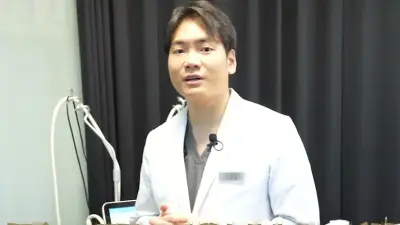
I am Dr. Yeonjin Kim, director of UH CELL Clinic's Gangnam location. When a patient in her late 40s comes in describing new heaviness along the lower cheek, I focus first on which layer moved rather than on her age.
Sagging Does Not Move the Same Way in Every Layer
The midface holds several distinct fat compartments stacked in front of the cheekbone, and they do not age in unison. Matthias Gierloff and colleagues reported in a 2012 computed tomography study published in Plastic and Reconstructive Surgery that midfacial fat compartments migrate downward with age, while the deeper cheek fat pad loses volume. Their scans, comparing younger and older cadavers, showed the distance between the fat compartments and the lower eyelid rim increasing with age, evidence of compartments settling lower on the face.
A follow-up imaging study using magnetic resonance imaging, published in Dermatologic Surgery in 2020, tracked 70 patients with an average age of 60 across two scans roughly 44.5 months apart. It found that superficial cheek fat lost both volume and thickness across every compartment measured, while only the lower compartments widened. In practical terms, the upper cheek hollows at the same time the lower cheek fills and drops. That is the pattern many of our patients describe as their face looking heavier along the jawline while the upper cheek looks flatter, even though nothing about their weight has changed.
Ultrasound and Radiofrequency Reach Different Depths
Ultrasound and radiofrequency devices are often discussed as interchangeable lifting options, but they act on different tissue. Adam Wulkan and colleagues, in a 2016 review published in Facial Plastic Surgery, described monopolar radiofrequency as stimulating collagen from the papillary dermis down through the deep reticular dermis, while microfocused ultrasound works at the deep reticular dermis and below. Ultrasound is also documented in the dermatology literature as capable of forming discrete thermal coagulation points at 1.5mm, 3.0mm, and 4.5mm depths without disturbing the surface of the skin.
That depth difference matters for cheek sagging specifically. If the descent we see in a consultation traces mainly to the deeper fat compartments Gierloff's group measured, ultrasound is positioned to reach that layer. If the superficial dermis has also lost elasticity, the pattern the 2020 MRI study associated with thinning superficial fat, radiofrequency's more superficial reach becomes relevant alongside it.
The evidence does not always separate the two options cleanly. Mohab Alhaddad and colleagues ran a randomized split-face trial, published in Dermatologic Surgery in 2019, comparing monopolar radiofrequency against microfocused ultrasound in 20 patients with mild to moderate skin laxity, followed for six months. They found no statistically significant difference in laxity grade improvement between the two treatment sides. When sagging is mild, the choice of device carries less weight. When several layers have shifted at once, how we sequence and combine treatments becomes the more important decision.
How We Structure a Late-40s Consultation
We start with a skin diagnostic to identify which layer shows the earliest signs of descent, then decide whether Ultherapy PRIME, Thermage FLX, Sofwave, or Potenza RF microneedling anchors the treatment plan, with the remaining devices used to support that primary layer. I hold Key Doctor certifications for Ultherapy and Potenza, and I set depth and energy settings against what the diagnostic shows rather than applying a fixed protocol regardless of the patient in front of me.
Our Gangnam location operates on the second and third floors of the UH FLAT SIGNATURE Gangnam hotel building, which lets a patient move from treatment room to recovery without leaving the building and return the next day for a follow-up check in the same space. UHC hotel guests can choose one complimentary benefit: a 30-minute oxygen chamber session or a vitamin IV drip. If both are used, the vitamin IV drip costs KRW 55,000.
FAQ
If cheek sagging is significant, is ultrasound alone enough?
Ultrasound targets the deep reticular dermis and the structures beneath it. When we also see reduced elasticity in the more superficial dermis during the diagnostic, adding radiofrequency to address that layer separately tends to produce a clearer treatment design than relying on one modality. Whether we combine the two depends on the layer distribution the diagnostic shows, not on a default protocol.
Is the late 40s too late to start addressing this?
The fat compartment changes documented in the imaging research are continuous across age groups rather than confined to a single decade. What matters more than when sagging began is which layer is actively changing right now, since that determines which treatment reaches it.
How much swelling or numbness should I expect afterward?
Dermatologist Doris Day, summarizing microfocused ultrasound outcomes in a 2014 clinical review, noted that patients may experience discomfort during the procedure along with temporary redness, swelling, and occasionally bruising. Recovery varies by individual, and we walk through the treated area and energy settings for your specific plan during the consultation.
Can consultation and treatment both happen during a short visit?
We schedule the diagnostic, treatment planning, procedure, and recovery check to take place within the same building. Japanese, Chinese, and English-speaking staff are based at the Gangnam location so diagnostic results and the treatment plan can be reviewed in your own language before you decide.




댓글 (0)
댓글 작성
댓글을 작성하려면 로그인이 필요합니다.
로그인하기