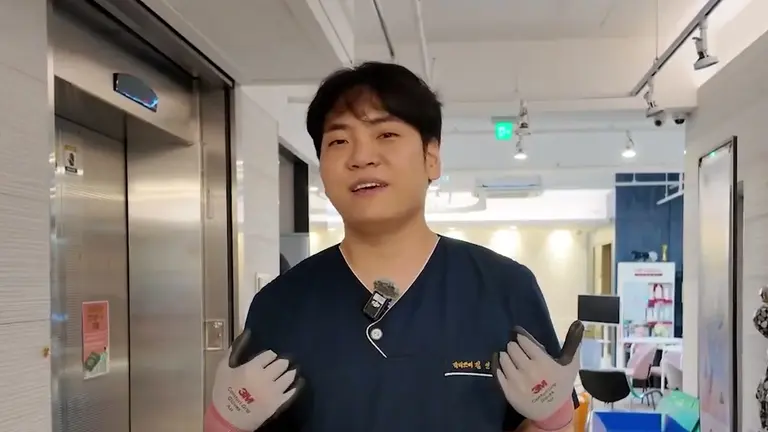
Public figures vet a Seoul clinic on three things: record privacy, care continuity, and discreet recovery. Here is how we handle all three in Gangnam.
A person whose face is part of their livelihood asks about record privacy, care continuity, and discreet recovery before asking about outcomes. Korean law criminalizes the disclosure of patient information learned during treatment, and at our Gangnam location, private-room treatment and hotel-based recovery are built around those same three concerns. We handle them together, in one building, for every patient who asks.
When a patient with a public-facing job books a consultation, the first questions are rarely about the procedure itself. They are about conditions: who will be in the room, what happens to the record afterward, and whether recovery means being seen. Patients who travel from abroad for treatment tend to ask in the same order, for a related reason: they have no way to verify a clinic's discretion from a distance, so they ask about the structure that enforces it before they book. South Korea's Ministry of Health and Welfare reported in April 2026 that the country treated 2.01 million foreign patients in 2025, the first time the annual figure passed two million since records began in 2009, and pointed to the global reach of K-pop, Korean dramas, and K-beauty content as part of the driver. Patients from the United States specifically rose 70.4 percent that year to a record 173,000. Dermatology accounted for the largest share of visits by specialty. The pattern behind the numbers is the same pattern we see in consultations: people are arriving with a specific set of conditions in mind, not just a treatment name.
Patient records are protected by law, not by policy
South Korea's Medical Service Act, Article 19, prohibits a medical professional or clinic staff member from disclosing or publishing information about a patient that they learned in the course of treatment. A 2016 amendment broadened the scope of what is protected: the earlier version of the law covered a patient's "secrets," and the amended version covers a patient's "information," a wider category that does not require the disclosed detail to have been sensitive to begin with. A violation carries a penalty under Article 88 of up to three years in prison or a fine of up to 30 million won. In a 2018 ruling, Korea's Supreme Court held that this protection extends to deceased patients as well as living ones, reasoning that the need to protect a patient's information does not end when the patient dies.
This is why we do not confirm whether a specific person has visited our clinic, regardless of who is asking or how the question is phrased. It is not a courtesy we extend selectively. It is the same rule applied to every record, and it is also why we do not use before-and-after photography to advertise a procedure: a comparison photo is itself a piece of patient information.
One physician follows the case from diagnosis to treatment
Two patients with the same lifting device can receive different depths of ultrasound energy and a different distribution of shots, because the underlying skin condition is different. We do not run a standardized package; a patient's skin is assessed first, and the treatment plan is built from that assessment rather than from a fixed menu. At our Gangnam location, that assessment and the treatment itself are handled by Dr. Kim Yeonjin, our director, who completed graduate study at Seoul National University, trained as a resident at Seoul National University Hospital, and serves as an Allergan faculty member for Juvederm and Botox as well as a Key Doctor for Potenza and Ulthera. Japanese, Chinese, and English interpreters are on staff at the Gangnam location, so a consultation does not lose detail in translation between the diagnosis and the plan a patient takes home.
Continuity matters here for a practical reason beyond comfort: a plan built around energy-based devices and injectables depends on a consistent read of how a patient's skin is responding across visits, something that is harder to track when the diagnosing physician and the treating physician are not the same person.
Recovery is the part that is easy to overlook
The visible part of a heat- or ultrasound-based procedure, redness and swelling, does not resolve the moment a patient leaves the treatment room. The longer the distance between the clinic and wherever a patient rests afterward, the longer that visible window lasts in public. Our Gangnam location operates on the second and third floors of the UH FLAT SIGNATURE Gangnam hotel, so treatment, recovery, and lodging sit inside the same building rather than requiring a separate trip across the city. Treatment takes place in a private room, and an oxygen chamber and vitamin IV drip are available at no additional charge to guests staying at the hotel.
For a short-stay patient, in particular, this changes the shape of a visit. A same-day return to a hotel room down the hall is a different recovery experience than a taxi ride across Seoul while still flushed from treatment, and a two-to-six-night stay can be planned so that the more visible recovery days happen before the last day of the trip, not on it.
Registration is a legal requirement, not a marketing claim
A clinic that treats patients from abroad is required, under Article 6 of the Act on Support for Overseas Expansion of Medical Business and Attraction of Foreign Patients, to register as a foreign-patient-attracting medical institution with the relevant provincial governor and to carry medical malpractice liability insurance. This registration status is not something a patient has to take on faith. It can be checked directly through Korea's Foreign Patient Attraction Information System, which lists registered institutions by name.
We mention this because a patient traveling for a short stay, without a way to independently verify a clinic in person beforehand, is right to check registration status rather than assume it. It is a public record, and checking it takes a few minutes before a trip is booked. For patients planning treatment around a fixed calendar date, such as an upcoming event with limited flexibility, the same logic applies to timing: work backward from the day recovery needs to be finished, not forward from the day treatment starts.
FAQ
Can you tell me which public figures have been treated at the clinic?
No. Article 19 of the Medical Service Act prohibits disclosing information learned during treatment, and whether a specific person has visited is itself information covered by that rule. This applies regardless of who is asking.
My stay in Seoul is short. When should treatment be scheduled?
The answer depends on the procedure category, since the days needed for visible redness or swelling to fade are different from the days needed for the treatment's full effect to appear. Scheduling works backward from the last day of the trip, the same approach we use for patients planning treatment around a wedding date.
Do I need to speak Korean for the consultation?
No. Japanese, Chinese, and English interpreters are on staff at the Gangnam location, so the diagnosis and aftercare instructions are communicated directly rather than through a delayed translation.
Will I encounter other patients while I'm there?
Treatment takes place in a private room, and appointment spacing is arranged to reduce overlap in common areas. If timing is a specific concern, mention it when booking so the schedule can be adjusted.

댓글 (0)
댓글 작성
댓글을 작성하려면 로그인이 필요합니다.
로그인하기