
Alltite lifting results come in two stages. Right after treatment, the skin feels tightened from the heat. Then, over roughly four to eight weeks, and sometimes up to twelve, new collagen forms and the lift becomes more visible. For general firmness care, the first course is three sessions spaced three weeks apart, followed by maintenance sessions every six to twelve months, set according to how the skin responds.
Hello. I'm Kyungsoo Kim, Representative Director of UH CELL Clinic Seocho. Alltite is not something you finish in a single visit. It is a program you repeat while watching how your skin responds session by session, and knowing when results show up and how many sessions to plan for helps you build a realistic schedule. You can read more about me and the rest of the Seocho medical team on the Seocho doctors page.
How Alltite Works Beneath the Skin
Alltite is a non-invasive lifting device built on DLTD technology (Dermis Layer Target Dielectric Heating System), which delivers heat to the elastic layer deep in the skin. It uses radiofrequency energy through dielectric heating instead of a simple surface pass, so the layers with more moisture, the mid-dermis, the fibrous septa, and the area near the SMAS, are selectively warmed while the surface stays cooled.
Collagen that absorbs this heat contracts right away, then regenerates over the following weeks. Instead of cutting the skin or threading it, Alltite delivers energy from outside the skin to trigger this contraction and regeneration. Focused ultrasound lifting (HIFU) works differently: it forms point coagulation at a set depth, while Alltite warms a broad, even surface, which changes how the heat spreads underneath.
When Results Appear and How Long They Last
The first change happens immediately. Heat contracts the collagen, and that tightened feeling is the first stage of Alltite's effect.
The second change comes from collagen remodeling. Contracted collagen regenerating into new collagen takes about four to eight weeks in most cases, and some references put the window closer to twelve weeks. Firmness and texture improve step by step during this stretch, so judging the result from the mirror the morning after is too early.
How long results last varies a great deal across sources. A single session is often described as lasting around two to three months, while completing the full first course is often described as lasting six to twelve months. Even so, the degree of sagging, skin thickness, and the number of shots used all shift this timeline for each person, so it is hard to promise one fixed number. The practical approach is to check how the skin looks once the first course is finished, then decide the next session's timing with the medical staff based on that result.
How Many Alltite Sessions You Need and How Far Apart
For general firmness care, the first course is recommended as three sessions, three weeks apart, or more. Published schedules vary here too, with some describing two to three sessions and others three to five, all spaced about three to four weeks (about a month) apart. Because Alltite is a program that builds on each session's firmness response, the number of sessions increases or shifts into maintenance depending on how much sagging is present, skin thickness, and how each session responds.
After the first course, maintenance sessions are spaced six to twelve months apart in most plans. The three to four week spacing of the first course and the multi-month spacing of maintenance serve different purposes. The first course is the period when collagen regeneration builds up to create the firmness change, while maintenance sessions carry that firmness forward.
Shortening the interval too much is best avoided. Heat-based lifting that repeats strong energy at close intervals is associated with a risk of volume loss, meaning a reduction in the fat under the skin, sometimes described as facial hollowing. More frequent or stronger sessions do not necessarily produce a better result, and this is part of why. Patients with a thinner face and less fat should discuss interval and energy strength carefully with the medical staff before choosing a schedule.
How Alltite Compares with Other RF and Ultrasound Lifting Treatments
The table below lines up four of the radiofrequency and ultrasound lifting treatments offered at UH CELL Clinic Seocho, showing how each delivers energy, what anesthesia it uses, and the general recommended interval.
| Treatment | How the energy works | Anesthesia | Typical recommended interval |
|---|---|---|---|
| Alltite | Dielectric heating (RF) warms the dermis and deep elastic layer while the surface stays cooled | None in most cases; numbing cream possible for sensitive skin | Every 3 weeks, 3 or more sessions |
| Oligio X | Monopolar 6.78MHz radiofrequency heats a broad area of the dermis | None in most cases, or numbing cream depending on sensitivity | Every 3 weeks, at least 3 sessions |
| Shurink Universe | Focused ultrasound (HIFU) forms coagulation points at a chosen depth | Numbing cream applied beforehand | About every 4 weeks, 3 or more sessions |
| InMode | Radiofrequency energy; the FX handpiece pairs it with vacuum suction, and FORMA heats the dermis evenly | None in most cases | Every 3 to 4 weeks, 3 or more sessions |
Oligio X also heats the dermis broadly and shares Alltite's three-week interval, but the way it delivers heat is different. Oligio X uses monopolar RF, while Alltite uses dielectric heating. You can find more on how Oligio X works and what the treatment involves on the Seocho Oligio X page. Shurink Universe forms coagulation points at a depth chosen by cartridge, which makes it suited to contoured, delicate areas like under the eyes, around the mouth, and along the jawline. InMode's FX handpiece uses vacuum suction to address areas with extra volume, such as a double chin or sagging cheeks. The intervals in the table are general guidance, and the actual schedule depends on skin condition and treatment goals.
Who Alltite Suits, and When the Plan Changes
Alltite is a treatment I can recommend to patients concerned about a sagging jawline, a collapsed jaw contour, deep midface volume loss, marionette lines, a double chin, or reduced skin firmness. It tends to fit easily into a schedule for early to moderate sagging, and for anyone without much room for pain or downtime.
Some situations call for a different plan. If the sagging comes largely from bone structure or a large amount of fat, another approach is considered first in most plans. Elderly patients with a very thin dermis, or anyone expecting an immediate, dramatic change, may not reach their goal with Alltite alone. Pregnancy, inflammation at the treatment site, and metal implants in the face all need to be mentioned during the consultation. A history of filler adjusts how the energy is set, and recent lifting treatments elsewhere call for spacing the schedule out. Details on filler areas and products used at Seocho are on the Seocho filler page, worth a look if you have had filler before.
Planning Alltite Around a Short Trip to Seoul
Since the first course runs on a three-week interval, a stay in Seoul shorter than three weeks, common for a short trip from mainland China, means planning for just one session on that visit in most cases, with the remaining sessions continuing on a later trip at the proper interval. Clustering sessions into a single stay isn't advisable, given the volume loss risk described earlier.
Treatment time runs about fifteen to thirty minutes, depending on the area, shot count, skin condition, and pain sensitivity. Most reactions are temporary, and daily life resumes quickly, so the detail worth more attention when a treatment overlaps with travel is aftercare. For about a week afterward, avoid saunas, hot springs, strenuous exercise, alcohol, and smoking, and keep up with sunscreen and moisturizer. If a hot spring visit is part of the trip, scheduling it before the treatment instead of after makes things easier.
Seocho clinic hours run Monday to Friday from 10:00 to 20:00, with last check-in at 18:30, and Saturday and Sunday from 10:00 to 17:00, with last check-in at 16:30. Booking online at least two to three days before the visit is recommended, and same-day appointments can be arranged by contacting the clinic directly.
How UH CELL Seocho Approaches Alltite Treatment
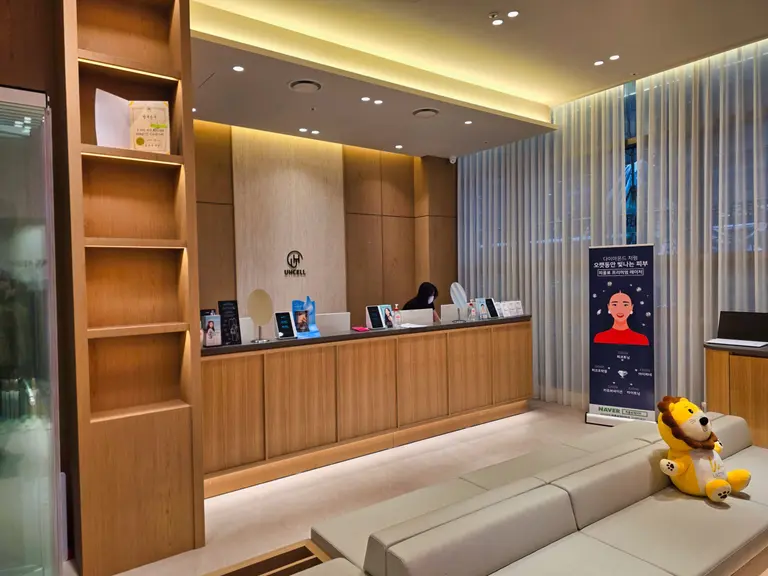
The equipment, injectables, and medications used at UH CELL Clinic Seocho are genuine, and they are opened in front of the patient before use. A skin assessment, listed separately as the EVE Test in the price guide, is available for anyone who wants a closer look at their skin condition first. Interpreting staff who can assist in Japanese, Chinese, and English work at the clinic.
The clinic is on the 1st floor of Seocho Roium Gisel (UH Flat The Seocho Annex), 30 Banpo-daero 16-gil, Seocho-gu, Seoul, a six-minute walk from Exit 6 of Nambu Terminal Station on Line 3. Parking is free for the first two hours, and staff can help if a visit runs longer.
What Alltite is meant to deliver is steady care for a sagging jawline and skin firmness without adding much recovery burden, and at UH CELL Seocho, the consultation covers the degree of sagging, skin thickness, and any filler or lifting history, so that shot count, the first course's interval, and the timing of maintenance sessions are decided together with the patient.
Frequently asked questions|FAQ
What does Alltite pricing depend on?
Cost is set largely by the shot count and the area treated. Whether you treat part of the face, the whole face, or extend down to the neck changes the shot count, and the number of sessions in the first course and any maintenance plan add to the total. The exact amount is best confirmed after a skin check determines the shot count and area.
Can I have Alltite without anesthesia?
Most patients go through the treatment without anesthesia, feeling a warm sensation during the session as the main thing noticed. Anyone sensitive to pain can discuss numbing cream with the medical staff beforehand, based on skin condition and treatment intensity.
What side effects should I watch for?
Right after treatment, redness, a warm feeling, mild swelling, stinging, and sensitivity can occur. These are temporary in most cases, with redness and light swelling settling within a day in most cases. Because this is a heat-based treatment, burns or prolonged warmth are possible in rare cases, so let the clinic know right away if redness or warmth doesn't settle down.
Can I get Alltite if I've had filler or Botox?
A history of filler or Botox doesn't rule out Alltite. The energy setting needs to be adjusted, so letting the medical staff know when and where you had filler helps with planning. Filler, Botox, and Alltite are scheduled with some spacing between them, as a rule, in place of on the same day.
When should I schedule Alltite before an important event?
For a wedding or a shoot, two to four weeks ahead works well, and if you want the firming effect to show by the date too, four to eight weeks ahead is a better target. That gives enough time for any initial redness to fade and for collagen regeneration to progress.
Skin response and recovery time vary by individual. Please consult a physician for an accurate diagnosis and treatment plan.
댓글 (0)
댓글 작성
댓글을 작성하려면 로그인이 필요합니다.
로그인하기