
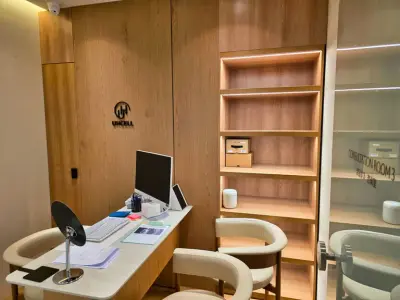
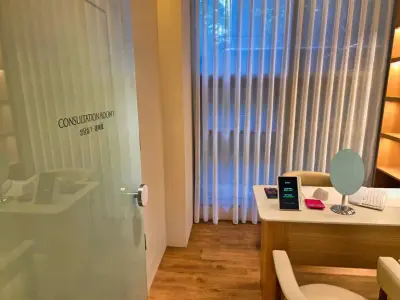
At UH CELL Clinic Gangnam, we offer Potenza RF microneedling together with Rejuran skin boosters, usually in that order, Potenza first and Rejuran second, and the clinic sits on the second and third floors of the UH FLAT SIGNATURE GANGNAM hotel building. Visitors sometimes ask about this pairing under the English term "gold microneedling," which is not a separate procedure name in Korea. It describes the general category of radiofrequency devices that use gold-plated microneedles to carry energy into the skin, and Potenza is one such device.

How the two treatments work together
Potenza drives very fine microneedles into the skin and releases radiofrequency energy once they reach the set depth, coagulating tissue and prompting new collagen formation. Our invasive Potenza tips come in 11 forms, split between multi-needle and single-needle designs: non-insulated tips that conduct energy along the full needle, insulated tips that concentrate energy only at the needle tip to limit damage to surrounding tissue, and pumping tips built to push a skin booster such as Rejuran or Juvelook straight into the channel the needle just made.
Rejuran is a skin booster made from PN (polynucleotide), a highly purified nucleic acid taken from salmon DNA with impurities removed. Unlike a volumizing filler, it works by stimulating the fibroblasts that produce collagen and elastin, so it behaves more like a regenerative injection than a filler. Its thicker consistency means a patient feels pressure as it goes in, and small raised bumps remain at each injection point for a short time afterward.
Combining the two makes sense because they cover different ground. The PN component supports recovery from the micro-channels and heat Potenza creates, while Potenza reaches a depth of collagen stimulation that PN alone does not reach as effectively. Put simply, Rejuran suits people who want it layered with laser treatments, and Potenza suits people who want a skin booster added to the same visit, so the two are often paired instead of run as unrelated appointments.
Downtime, pain, and what changes the answer
On its own, Rejuran's downtime is the embossing and bruising that lasts one to three days, and the appointment takes 40 to 50 minutes including numbing. Potenza's downtime is three to seven days for the invasive tips, with no downtime for the non-invasive version, and the appointment itself runs about 30 minutes; both procedures start with thorough topical anesthesia. Combine the two on the same day and the two recovery windows overlap, which tends to make redness stronger and longer than a Potenza session alone, so it is worth setting a return flight or an important event safely past the longer end of the Potenza downtime window instead of the shorter Rejuran one. Spacing the sessions one to two weeks apart splits the downtime into two lighter stretches instead, at the cost of needing more total days in Seoul, so the choice tends to follow how long a visitor can stay: a single-visit schedule points to doing both on the same day, while a trip long enough to allow a return visit points to splitting them.
The pain is different in kind instead of just in degree. Potenza's needles bring a stinging sensation on entry and a warming feeling as the radiofrequency passes through, even with numbing cream applied beforehand. Rejuran's discomfort comes largely from the pressure of injecting a thick fluid, and it is felt more around the under-eye area, the mouth, and the forehead than on the cheeks, so which treatment feels worse comes down to the area being treated and how thick the skin is there. Options that ease this include a lidocaine-containing Rejuran formulation, injector delivery, and delivery through the Potenza pumping tip, all worth raising during the consultation along with any plan to split or combine the sessions. For visitors from China booking this combination at UH CELL Clinic Gangnam, interpreting staff who can assist in Japanese, Chinese and English work at the clinic, so these scheduling and delivery-method questions about Potenza and Rejuran can be asked directly in place of through a third party.
Risks and aftercare to plan around
Combining the two procedures largely adds to the intensity and length of redness in place of introducing a new category of risk. Temporary redness, swelling, and small spots of bleeding under the skin can follow either treatment, and pigmentation changes or burns are possible though uncommon; these relate to how Potenza's energy settings are tuned for darker skin tones in place of to adding Rejuran on top. Pregnancy, autoimmune disease, active severe acne, and a tendency toward keloid scarring are reasons to flag the treatment during consultation, and it is safer to leave one to two weeks between this combination and other injectables such as botox or filler.
Afterward, avoid washing the face, applying makeup, using a sauna, or exercising hard for 24 hours, use a gentle moisturizer for three days, and apply SPF50+ sunscreen for two weeks. Cutting back on alcohol and skipping scrubs or retinoids for one to two weeks also helps the skin settle. Contact the clinic where the procedure was done if any of the following appear:
- Swelling that keeps growing after three or four days
- Blistering
- Skin turning a deep purple color
- Pus
- A firm lump that won't shrink
These signs call for prompt attention in place of waiting out the normal downtime window.
댓글 (0)
댓글 작성
댓글을 작성하려면 로그인이 필요합니다.
로그인하기