UH CELL Clinic Seocho explains how cheek volume loss differs from skin laxity, what Sofwave targets, and why U.S. clearance must be distinguished from Korean authorization.
A shadow beneath the cheekbone and a softened jawline can look similar, but volume loss and skin laxity need separate assessment. They can also occur together. Sofwave targets skin tissue rather than adding volume, so clarify the main concern before a consultation at UH CELL Clinic Seocho.
Hello, I'm Dr. Kim Kyungsoo, director of UH CELL Clinic Seocho.
We list Sofwave under our lifting treatments, not our volume treatments, and that distinction matters more than the device name itself. A consultation that skips it risks setting an expectation the treatment was never designed to meet.
Why the Two Problems Look the Same in the Mirror
Facial appearance is not just a skin question. Fat pads, muscle, and the underlying bone all contribute to how a face reads at a glance, so a hollow area below the cheekbone and a loose jawline can show up together and still have different origins. A shadow by itself does not tell us which one it is.
We ask patients to think through three things before their first visit: whether their weight has changed meaningfully in the past year, when a specific area first started bothering them, and whether they have had filler or a lifting procedure before. Old photos help place a timeline on the change, but lighting and camera angle can exaggerate a difference that never actually happened, so we treat photos as a starting reference rather than a diagnosis.
What you notice
What we sort out in consultation
What we do not assume
Hollow look under the cheekbone
Volume loss versus shadow from surrounding tissue
That a lifting treatment will refill it
Loose skin, fine lines
Degree of skin laxity
That everyone responds to the same device the same way
Softer jawline
How much skin, fat, and bone structure each contribute
That a blurred jawline is always a skin problem
What Sofwave Is Actually Designed to Change
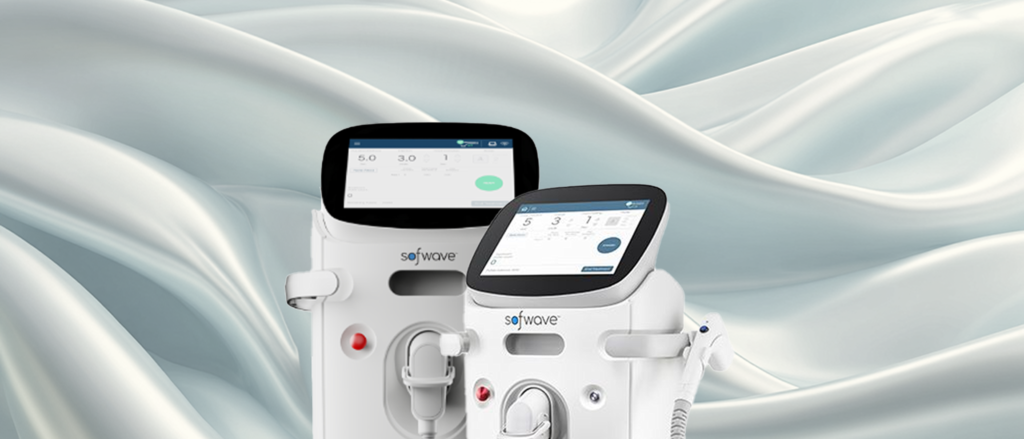
We describe Sofwave as a device that delivers parallel ultrasound beams to the mid-dermis, at a depth of roughly 1.5mm, to prompt a collagen and elastic-fiber response. That mechanism tightens existing skin tissue rather than adding new volume.
The U.S. Food and Drug Administration's 2021 clearance of Sofwave's expanded indications covers improvement of facial lines and wrinkles, eyebrow lift, and lifting of lax submental (under-the-chin) and neck tissue in patients 22 and older. That clearance is a U.S. regulatory document, and it does not automatically define how the device is described or used under the Korean regulatory authorization; anyone considering the treatment should confirm the indication and instructions that apply in Korea rather than assume the two are identical.
The mechanism itself draws a clean line: a treatment aimed at skin tension can visibly change how skin sits on the face, but it does not fill in a hollow caused mainly by lost volume.
The Question Patients Should Also Ask: Could Hollowing Get More Noticeable?
That the device targets a defined depth in the dermis is useful information, but a design target is not a guarantee that nothing else changes for every patient. Skin thickness, existing volume, treatment area, and individual healing all vary, so we do not treat the mid-dermis target as a promise about how a specific face will respond.
If a patient already has thin volume, or contour changes after a previous procedure, we want to hear that before treatment, not after. In consultation we go through whether the treatment is a fit for that starting point, whether any area should be avoided or adjusted, and how we explain expected reactions such as soreness, redness, or swelling. A flat assurance that "no fat is ever lost" is less useful to a patient than an answer built around their own skin and history.
Four Things Worth Noting Before Your Visit
Start with the specific area that bothers you. "My whole face looks tired" is harder to work from than "the shadow under my cheekbones" or "the loose skin under my jaw." A specific description makes the consultation questions sharper.
Note when the change started. Was it around a period of weight change, after a specific procedure, or did it happen gradually over time? If you remember the name and date of an earlier treatment, bring that too.
Decide what you actually want prioritized. Fine lines, skin tone and elasticity, and added volume do not always get solved by the same treatment, so naming your priority in advance helps the consultation stay focused.
Tell us your schedule. If there is an event or a flight home on a fixed date, we need that information before deciding on timing, because skin needs time to show its response and we do not plan around an assumption that results will be finished by a specific day.
What to Check Beyond the Device Name
We offer more than one lifting, skin-booster, and volume-related treatment at our Seocho clinic, and having several options on a menu does not mean combining them is the right plan for any one patient. What matters first is naming the actual goal and understanding what a given treatment can and cannot reach.
Once it is clear whether skin laxity, volume loss, or both are driving what a patient sees, the questions worth asking in consultation change accordingly. In some cases the right next step is not to treat immediately, but to have a fuller evaluation first.
FAQ
Does having hollow cheeks rule someone out for Sofwave?
Not automatically. Hollowing alone is not a disqualifier; it needs to be assessed alongside whether skin laxity is also present, and that assessment happens in person rather than from a description of symptoms.
Can I judge the result right after the treatment?
An immediate sensation or swelling should not be treated as the settled outcome. Ask the clinician when and how progress should be evaluated for your individual treatment.
Can photos alone tell volume loss and skin laxity apart?
They can help establish a timeline, but lighting and angle affect how a photo reads, so we use them as a reference point going into a consultation rather than as the basis for a treatment decision. An in-person exam is what actually separates the two.
How soon should I expect to see a change?
Collagen remodeling takes time to show, which is part of why we ask about your schedule up front rather than promising a result by a fixed date. We discuss a realistic timeline for follow-up during the consultation itself.
Individual response and recovery time vary. Please discuss your specific diagnosis and treatment plan with your physician.




댓글 (0)
댓글 작성
댓글을 작성하려면 로그인이 필요합니다.
로그인하기