
Fast Swelling Recovery Before an Event: It's the Conditions, Not the Procedure
Hello, I am Dr. Kim Yeon-jin, Chief Physician at UHCELL Clinic Gangnam. If you have an event next week and you are searching for "the procedure that clears swelling fast," I want to correct the premise before we go further: there is no procedure that inherently clears swelling fast. There is a recovery environment that clears swelling fast. The same treatment produces very different downtime depending on how many days you have left and how the first hours after your appointment are managed, which is why, at the start of every consultation, we ask how many days remain before we ask which treatment you have in mind.
Matching the Procedure to Your Remaining Days
Botox, skin boosters, and toning lasers carry the shortest downtime, and many patients return to normal social activity within two to three days. Lifting devices such as HIFU or Thermage, and most fillers, generally call for three to five days of recovery, and filler placed in thin, vascular areas such as under the eyes or the lips can extend that window to five to seven days. Thread lifting is associated with a longer return to social activity, typically one to two weeks. If your event is three days away, that arithmetic points toward the skin-booster or Botox range rather than a lifting device or filler.
These windows are averages, not guarantees. Swelling after Ulthera- or Thermage-class treatments typically settles within about a week, but skin thickness, the position of small vessels near the surface, and even how your body reacted on treatment day all shift that curve in either direction. This is exactly why we run a skin diagnosis before settling on a procedure — predicting downtime from a treatment name alone, without seeing the skin it will be used on, is not something we consider reliable practice.
The First 48 Hours Decide More Than the Device Does
Regardless of which treatment you choose, one variable applies across almost all of them: whether cold compresses are applied in the first 48 hours has an outsized effect on how much swelling and bruising you end up with. Alcohol, sauna heat, and intense exercise during this window widen blood vessels, which can make swelling and bruising worse rather than better — this mirrors post-procedure guidance published by U.S. plastic-surgery clinics, which generally advise avoiding heavy exercise, alcohol, and heat exposure for at least 24 to 48 hours after filler to limit swelling. That is why we advise avoiding all three for three to four days after Botox or filler.
Bruising from filler injections usually resolves within 10 to 14 days, according to a case report on filler-related bruising published in the journal Clinical Case Reports, though timelines vary by individual and treated area, and delicate, highly vascular sites such as the lips or under-eyes can take longer to clear. Skin boosters, which leave only fine puncture marks, tend to have shorter visible downtime when aftercare is followed closely, sometimes fading within a day or two.
In other words, roughly half of what determines your downtime is the procedure you choose, and the other half is how quickly you get into cold compresses and structured recovery care immediately afterward. When a patient leaves the treatment room and disperses straight into a full schedule, that early 48-hour window is often the piece that gets skipped.
Why We Built Recovery Into the Same Building as the Treatment Room
Hyperbaric oxygen therapy works by placing the body in a chamber pressurized above normal atmospheric levels and delivering high-concentration oxygen, which raises the amount of oxygen dissolved directly in the blood plasma. According to Johns Hopkins Medicine, hyperbaric oxygen therapy helps healing by bringing oxygen-rich plasma to tissue that has been starved of oxygen after an injury, since damaged vessels leak fluid into surrounding tissue and that swelling can itself block oxygen from reaching cells. Separately, a clinical review from the National Center for Biotechnology Information notes that hyperbaric oxygen exposure is associated with decreased surrounding edema and increased neovascularity in affected tissue. That said, individual response to post-procedure swelling varies, and whether hyperbaric oxygen is appropriate for a given patient is a decision we make during consultation, not a guarantee we extend in advance.
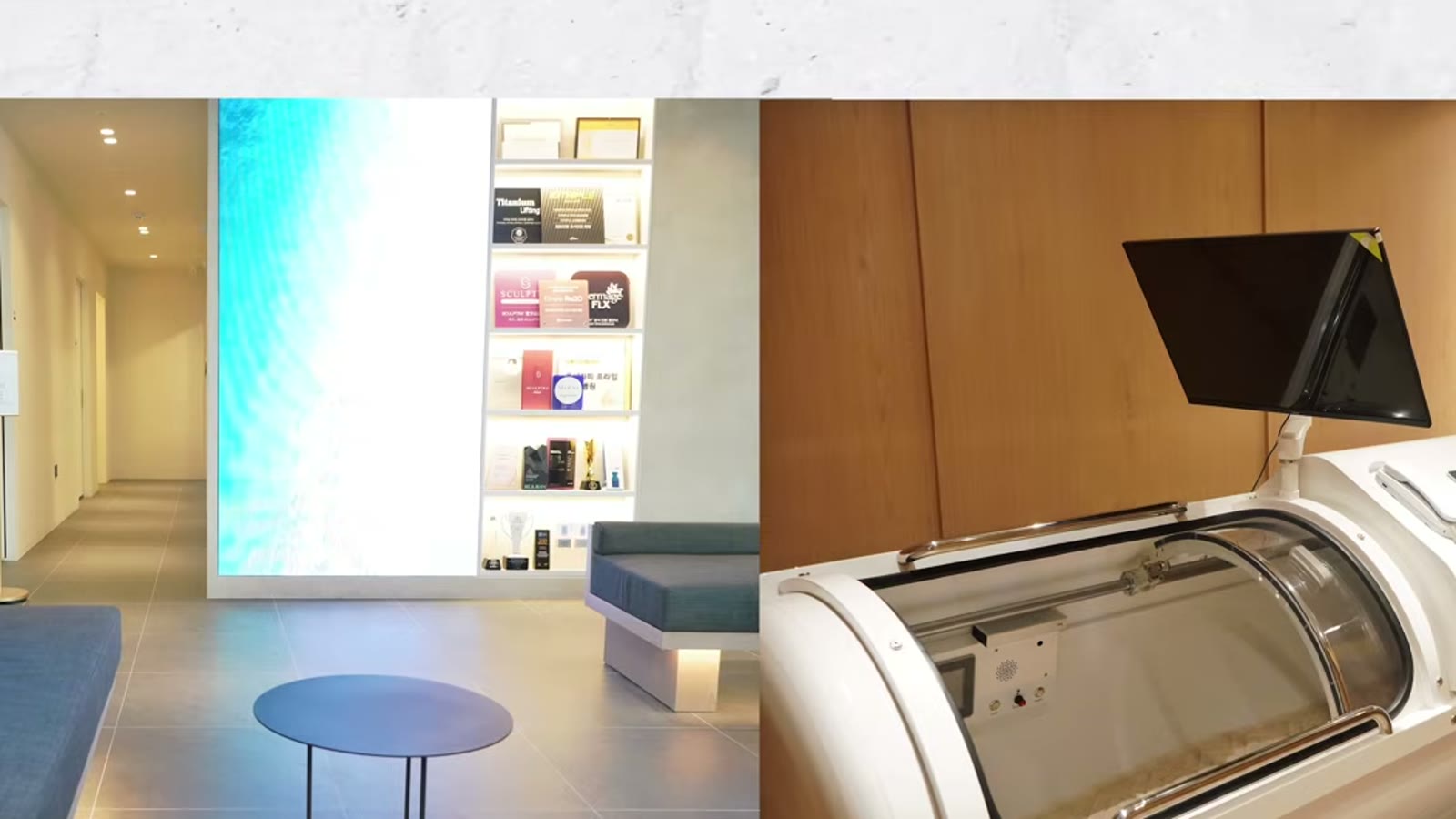
Both of our locations, in Gangnam and Seocho, operate as on-site amenities inside a hotel building rather than as separate clinics with a nearby partnership arrangement — the Gangnam location sits inside UH FLAT SIGNATURE Gangnam, and the Seocho location inside UH FLAT The Seocho. Because of that, treatment and recovery happen within the same building. We run a hyperbaric oxygen chamber and a vitamin IV drip program for hotel guests, and the reason we built it this way is straightforward: it creates a path where the 48-hour aftercare window is something a patient can actually follow through on rather than a set of instructions they carry home and try to remember.
For a patient visiting Seoul on a short itinerary, the commute from clinic to hotel is often where the first few hours of aftercare quietly disappear. When a patient can move from the treatment room to a chamber in the same building for oxygen support, then follow with a vitamin IV drip for hydration and nutrients, the gap in early cold-compress-era care narrows considerably.
Three Questions Worth Asking at Consultation
If you are choosing a procedure against a fixed calendar date, it is worth asking three things directly. First, has the clinic actually diagnosed your skin and matched a treatment range to your remaining days, rather than recommending by treatment name alone? Second, where and how is cold-compress and early aftercare actually carried out — is there a concrete plan, or just a printed handout? Third, is recovery infrastructure such as hyperbaric oxygen or IV drips physically separate from the treatment space, or built into the same route a patient already has to walk? Without these three pieces in place, even a technically excellent procedure can leave visible swelling on the date you were planning for.
At both our Gangnam and Seocho locations, we run a skin diagnosis first, design a treatment combination around the days a patient has left, and walk them through the same-building path to hyperbaric oxygen and IV recovery care starting at the consultation stage — before any treatment decision is finalized.
FAQ
Is there a procedure that reduces swelling especially fast?
No single procedure is inherently free of swelling. Lower-intensity treatments such as Botox or skin boosters tend to carry shorter downtime, but even lifting treatments and fillers vary considerably in recovery speed depending on individual skin condition and how aftercare is handled in the first two days.
My event is only three days away — can I still get a lifting treatment?
HIFU- and Thermage-class treatments generally call for three to five days of recovery, so three days can be tight. During consultation we can look at adjusting treatment intensity or shifting toward the skin-booster or Botox range depending on what your skin diagnosis shows.
When can I go back to the sauna after a procedure?
Alcohol, sauna heat, and intense exercise widen blood vessels and can worsen swelling and bruising, so we generally recommend avoiding all three for at least three to four days. The exact window depends on which treatment you had, so confirm the specific timing with your treating physician.
Is hyperbaric oxygen available to anyone?
At both our Gangnam and Seocho locations, the chamber program runs for hotel guests. Whether it is appropriate for a given patient, and at what point after treatment, depends on the procedure performed and individual health factors reviewed at consultation.
Why do sensitive areas like the under-eyes or lips take longer to heal?
Areas with thinner tissue and more surface-level small vessels tend to show more visible bruising and swelling after filler injection, which is why we typically plan a five- to seven-day recovery window for those sites rather than the shorter timeline used elsewhere on the face.


댓글 (0)
댓글 작성
댓글을 작성하려면 로그인이 필요합니다.
로그인하기